Platform Engineering: Building Internal Developer Platforms That Actually Work
Dennis Weston
November 26, 2025
Quick Navigation
- The Problem
- What Platform Engineering Solves
- Core Components of an IDP
- Implementation Strategy
- Common Mistakes
- Your Next Move
The Problem
Every team builds the same infrastructure differently. Development wants Kubernetes. Operations wants stability. Security wants compliance. Nobody agrees on tooling.
Developers wait weeks for infrastructure. Operations tickets pile up. Security reviews delay releases. Teams build shadow IT to work around bottlenecks.
This isn't just inefficiency. It's risk. Each team's custom solution introduces unique vulnerabilities, compliance gaps, and operational complexity. When issues arise, nobody knows how to fix them because every environment is a snowflake.
The Productivity Tax
We've watched engineering organizations lose 30-40% of developer productivity to infrastructure toil. Developers spend days configuring CI/CD pipelines, setting up monitoring, managing secrets, and debugging deployment issues—work that has nothing to do with the product they're building.
Meanwhile, platform teams drown in tickets: "Can you provision a database?" "Why is my deployment failing?" "I need access to production logs." These requests are repetitive, manually intensive, and prevent platform teams from working on actual improvements.
The result: slow delivery, frustrated developers, and platform teams stuck in reactive mode.
What Platform Engineering Solves
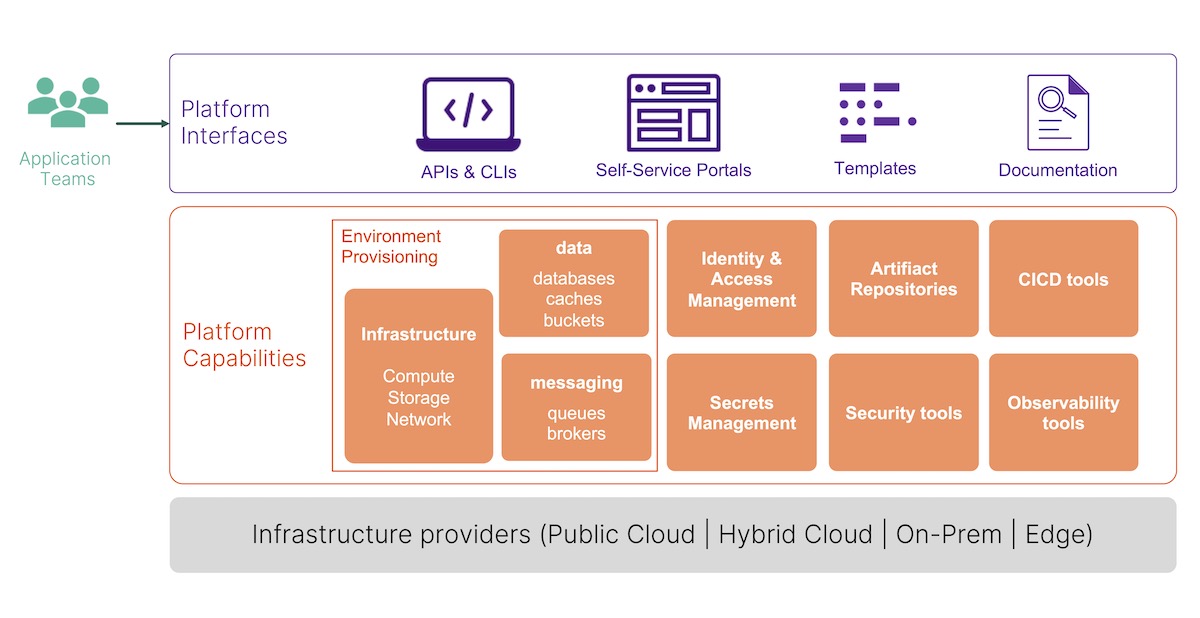
Platform engineering builds Internal Developer Platforms (IDPs) that provide self-service infrastructure with built-in best practices.
Instead of developers submitting tickets and waiting, they provision infrastructure themselves through standardized, secure templates. Instead of each team maintaining custom CI/CD pipelines, they use a shared platform with proven patterns. Instead of manual security reviews, security controls are baked into the platform.
The Golden Path
Platform engineering creates "golden paths"—pre-approved, optimized ways to accomplish common tasks. Need a new microservice? Use the service template. Need a database? Self-service provision with automatic backups, encryption, and access controls.
Developers get autonomy. Platform teams maintain standards. Security gets compliance. Operations gets consistency.
Core Components of an IDP
Self-Service Infrastructure
Developers provision resources through simple interfaces—CLI, web portal, or API. Behind the scenes, infrastructure-as-code templates ensure resources are created consistently and securely.
Service catalogs - Browse available infrastructure components. Select what you need. Configure parameters. Deploy.
Automated provisioning - Click a button, get a fully configured environment with networking, security, monitoring, and logging already set up.
Policy enforcement - The platform automatically applies security policies, compliance controls, and organizational standards. Developers can't accidentally create public S3 buckets or overly permissive IAM roles.
Integrated Developer Experience
The platform abstracts complexity while maintaining flexibility.
Unified workflows - One CLI or API for all infrastructure operations. Developers don't learn separate tools for networking, compute, storage, and security.
Built-in observability - Every deployment automatically includes metrics, logs, and tracing. No manual instrumentation required.
Standardized CI/CD - Pipeline templates for different languages and frameworks. Developers customize business logic, not build infrastructure.
Developer Portals
A single interface showing everything developers need:
- Services they own
- Resource usage and costs
- Deployment status
- Service health metrics
- Documentation and runbooks
- Self-service troubleshooting
Backstage (from Spotify) and similar tools provide this visibility.
Infrastructure Abstraction
Platform teams manage the underlying infrastructure complexity. Developers interact with simple abstractions.
Environment parity - Development, staging, and production environments are created from identical templates. "Works on my machine" problems disappear.
Automatic scaling and resilience - Platform handles auto-scaling, health checks, and failure recovery. Developers focus on application logic.
Security by default - Encryption, network policies, secret management, and compliance controls are standard, not optional.
Implementation Strategy
Phase 1: Identify Repetitive Patterns
Survey development teams. What infrastructure do they repeatedly request? What takes the most time to set up? What breaks most often?
Common patterns:
- New microservices (container orchestration, networking, CI/CD)
- Databases (provisioning, backups, access control)
- Message queues (configuration, monitoring, scaling)
- Storage buckets (encryption, access policies, lifecycle management)
Start with the most common, highest-pain workflows.
Phase 2: Build Golden Paths
Create opinionated, pre-approved templates for these patterns.
Service templates - Infrastructure-as-code that provisions complete, production-ready environments. Include networking, security groups, monitoring, logging, and CI/CD.
Documentation - Clear getting-started guides. Examples showing common use cases. Troubleshooting runbooks.
Guardrails, not gates - Make the right way the easy way. Developers can deviate when necessary, but the golden path should handle 80% of cases.
Phase 3: Enable Self-Service
Provide interfaces for developers to use these templates without platform team involvement.
Portal or CLI - Simple, intuitive access to infrastructure provisioning.
Automated approvals - Most requests auto-approve based on policy. Only exceptional cases require manual review.
Immediate feedback - Developers see deployment status in real-time. Errors provide actionable remediation steps.
Phase 4: Measure and Iterate
Track metrics that demonstrate platform value:
- Time to provision infrastructure - How long from request to running environment?
- Developer satisfaction - Are developers using the platform? Do they recommend it?
- Platform team ticket volume - Are repetitive requests decreasing?
- Deployment frequency - Can teams deploy more often?
- Mean time to recovery - When issues occur, how quickly are they resolved?
Use feedback to improve the platform continuously.
Common Mistakes
Building for Platform Teams, Not Developers
Platform teams sometimes build what they think developers need, not what developers actually need.
Talk to developers. Understand their workflows. Solve their pain points. If the platform doesn't make developers' lives easier, it won't be adopted.
Over-Abstracting
Some platforms hide so much complexity that developers can't diagnose issues or optimize performance.
The right abstraction level depends on your organization's maturity. Give developers enough control to debug and optimize, but abstract away unnecessary complexity.
Ignoring the Paved Road
If the "golden path" is harder than doing it manually, developers will bypass the platform.
The approved way must be easier, faster, and more reliable than the manual alternative.
No Clear Product Ownership
Internal platforms need product management. Someone must:
- Gather developer requirements
- Prioritize features
- Coordinate development
- Measure adoption and impact
- Evangelize the platform
Without product ownership, platforms become collections of disconnected tools that nobody uses.
Your Next Move
Start small. Pick one pain point—maybe provisioning new services or configuring CI/CD—and build a self-service solution.
Prove value with a single team. Refine based on feedback. Then expand to more teams and more use cases.
Platform engineering is a journey. Start walking.
Work With Us
Tech Blend helps enterprises build Internal Developer Platforms that accelerate delivery without sacrificing security or compliance.
If your organization needs help with:
- Platform strategy and architecture
- Developer portal implementation (Backstage, custom solutions)
- Infrastructure-as-code templates and automation
- Self-service workflows and policy enforcement
Get in touch: Email us at sales@techblendconsult.io
References
Want more insights like this?
Subscribe to get weekly DevSecOps guides, security best practices, and infrastructure tips delivered to your inbox.
No spam. Unsubscribe anytime.