FinOps: Bringing Financial Accountability to Cloud Spending
Dennis Weston
November 23, 2025
Quick Navigation
- The Problem
- What FinOps Actually Is
- The FinOps Lifecycle
- Implementation Strategy
- Common Mistakes
- Your Next Move
The Problem
Your AWS bill doubled this quarter. Nobody knows why. Engineering says it's not them. Finance demands answers. Operations doesn't have visibility into what's driving costs.
This scenario plays out in enterprises constantly. Cloud spending grows unchecked because:
- Engineers provision resources without knowing costs
- No single team owns the cloud budget
- Usage isn't attributed to specific projects or teams
- Optimization is reactive, not proactive
We've seen companies spend $2M annually on resources nobody uses. Dev environments running 24/7 when they're only needed during business hours. Databases over-provisioned by 10x. Storage growing indefinitely without lifecycle policies.
Why Cloud Costs Spiral
Traditional infrastructure had natural constraints: physical servers, fixed capacity, capital budgets. You couldn't accidentally triple your datacenter overnight.
Cloud removes these constraints. Developers spin up instances with a click. Auto-scaling adds capacity automatically. No purchase orders. No approvals. Unlimited scale.
This flexibility is cloud's power and its danger. Without financial accountability, costs grow faster than revenue.
What FinOps Actually Is
FinOps (Financial Operations) brings financial accountability to cloud spending through collaboration between finance, engineering, and operations teams.
It's not about reducing costs at all costs. It's about understanding costs, attributing them correctly, and making informed tradeoff decisions between speed, quality, and cost.
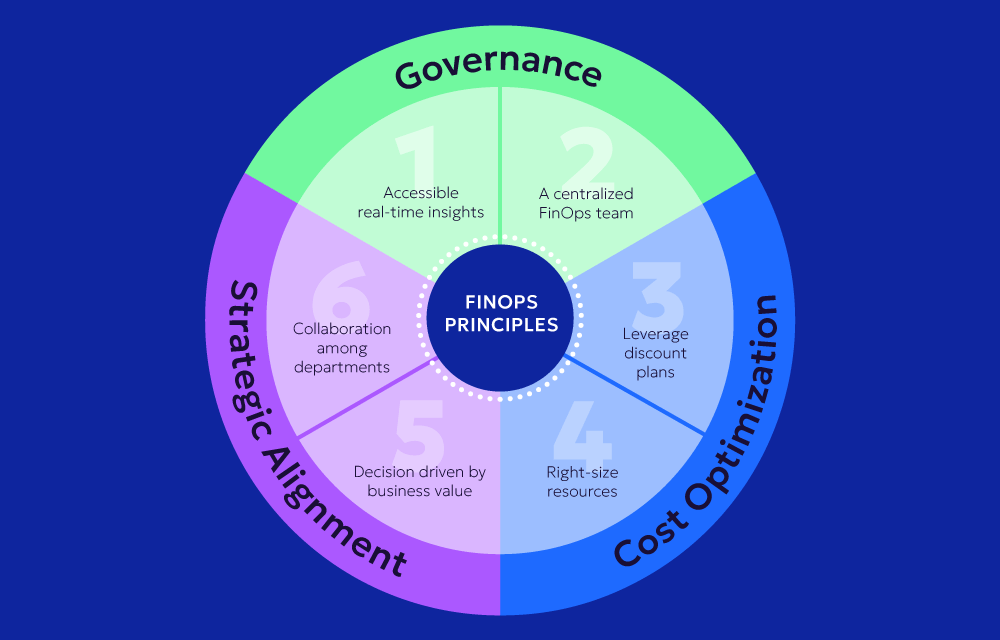
Core Principles
Teams collaborate - Finance provides cost data and targets. Engineering makes architectural decisions. Operations implements optimization. Everyone shares responsibility for cloud spend.
Everyone takes ownership - Engineering teams see the cost impact of their decisions in real-time. Product teams understand infrastructure costs per feature. Business units track ROI on cloud investments.
Centralized team drives FinOps - A dedicated team provides tools, reporting, and best practices. They don't control spending—teams do—but they enable informed decisions.
Data-driven decisions - You can't optimize what you don't measure. Track costs at granular levels: per service, per team, per product, per customer.
Variable cost model - Embrace cloud's pay-per-use model. Right-size resources. Use spot instances. Shutdown unused environments. Match spending to actual business value delivered.
The FinOps Lifecycle
FinOps operates in three phases: Inform, Optimize, Operate.
Inform: Understand Your Costs
You can't manage cloud spending without visibility.
Tag everything - Every resource gets tags: cost center, team, environment, project. Enforce tagging policies at provisioning time. Untagged resources get flagged or shut down.
Allocate costs accurately - Shared resources (networking, security tools, logging) are allocated to teams based on usage. No "mystery spend" or unallocated costs.
Create visibility - Dashboards showing costs by team, service, environment. Daily spend trends. Anomaly detection. Forecasting.
Benchmark and budget - Establish baselines. Set targets. Track variance. Forecast future costs based on growth plans.
Optimize: Reduce Waste
Once you understand spending, optimize it.
Right-size resources - Most instances are over-provisioned. Right-sizing saves 20-40% typically. Analyze utilization. Downsize underutilized resources.
Eliminate waste - Idle instances. Orphaned volumes. Unattached load balancers. Snapshots kept forever. Delete unused resources.
Use pricing models effectively - Reserved instances for steady-state workloads (40-60% savings). Spot instances for fault-tolerant workloads (70-90% savings). Savings Plans for flexibility.
Implement auto-scaling - Match capacity to demand. Scale down during off-peak hours. Shutdown dev/test environments nights and weekends.
Optimize storage - Lifecycle policies to move old data to cheaper tiers. Delete unnecessary snapshots. Use appropriate storage classes.
Operate: Continuous Improvement
FinOps isn't a one-time project. It's ongoing.
Establish policies - Budget alerts. Auto-shutdown for tagged environments. Approval workflows for large resource requests.
Automate optimization - Scripts that right-size instances. Auto-cleanup of unused resources. Scheduled scaling.
Cultural change - Make cost visibility part of engineering culture. Include cost metrics in sprint reviews. Celebrate cost optimization wins.
Implementation Strategy
Phase 1: Establish Visibility
Start with basic cost visibility.
Enable cost allocation tags - Define tagging strategy. Enforce through policy. Tag existing resources retroactively.
Set up cost dashboards - Use native tools (AWS Cost Explorer, Azure Cost Management, GCP Cost Management) or third-party platforms (CloudHealth, Apptio, Cloudability).
Identify top spenders - Which services cost most? Which teams? Which projects? Find the 20% of resources driving 80% of costs.
Phase 2: Build FinOps Team and Processes
FinOps requires dedicated focus.
Establish FinOps team - Members from finance, engineering, and operations. They drive strategy, provide tools, and facilitate collaboration.
Create communication channels - Regular cost reviews with engineering teams. Shared dashboards. Slack channels for cost discussions.
Define KPIs - Unit economics (cost per customer, per transaction, per API call). Efficiency metrics (cost as % of revenue). Waste metrics (% of spend on idle resources).
Phase 3: Implement Quick Wins
Prove value with easy optimizations.
Shutdown non-production environments outside business hours - Immediate 60-70% savings on those resources.
Delete unattached EBS volumes - Often forgotten when instances are terminated. Quick savings.
Right-size obviously oversized instances - CPU utilization under 10%? Downsize.
Purchase Reserved Instances for stable workloads - Analyze usage patterns. Commit to RIs where usage is predictable.
Phase 4: Enable Engineering Teams
Give teams tools to self-optimize.
Cost visibility in CI/CD - Show estimated cost impact of infrastructure changes before deployment.
Dashboards per team - Teams see their spending in real-time. Set budgets. Track trends.
Cost optimization recommendations - Automated suggestions for right-sizing, RI purchases, spot instance usage.
Gamification - Leaderboards showing teams with best cost efficiency. Rewards for optimization wins.
Common Mistakes
Treating FinOps as Pure Cost-Cutting
FinOps isn't about minimizing spend. It's about maximizing value.
Sometimes the right decision is to spend more—faster instances improve customer experience, additional redundancy improves reliability. FinOps provides data to make these tradeoffs consciously.
No Executive Sponsorship
FinOps requires cultural change. Without executive support, it fails.
Finance, engineering, and product leadership must all champion FinOps. When executives ask about cost in every planning meeting, teams pay attention.
Focusing Only on Infrastructure Costs
Infrastructure is easy to measure. But labor costs for managing inefficient infrastructure often exceed the infrastructure costs themselves.
Factor in total cost: infrastructure + operational overhead + opportunity cost of engineers managing complexity instead of building features.
Blaming Teams for Costs
"Your team spent $50k this month!" without context creates defensiveness, not improvement.
Instead: "Your cost per customer increased 20%. What changed? How can we optimize?" Frame cost discussions as collaborative problem-solving.
Your Next Move
Start measuring. Enable cost allocation tags. Set up dashboards showing spend by team and service.
Identify one quick win:
- Shutdown dev environments overnight
- Delete unused resources
- Right-size obviously oversized instances
- Purchase RIs for stable workloads
Show savings. Build momentum. Expand FinOps practices incrementally.
Work With Us
Tech Blend helps enterprises implement FinOps practices that balance cost optimization with business value delivery.
If your organization needs help with:
- FinOps strategy and team structure
- Cost visibility and tagging implementation
- Optimization automation and tooling
- Cloud financial management culture change
Get in touch: Email us at sales@techblendconsult.io
References
Want more insights like this?
Subscribe to get weekly DevSecOps guides, security best practices, and infrastructure tips delivered to your inbox.
No spam. Unsubscribe anytime.